
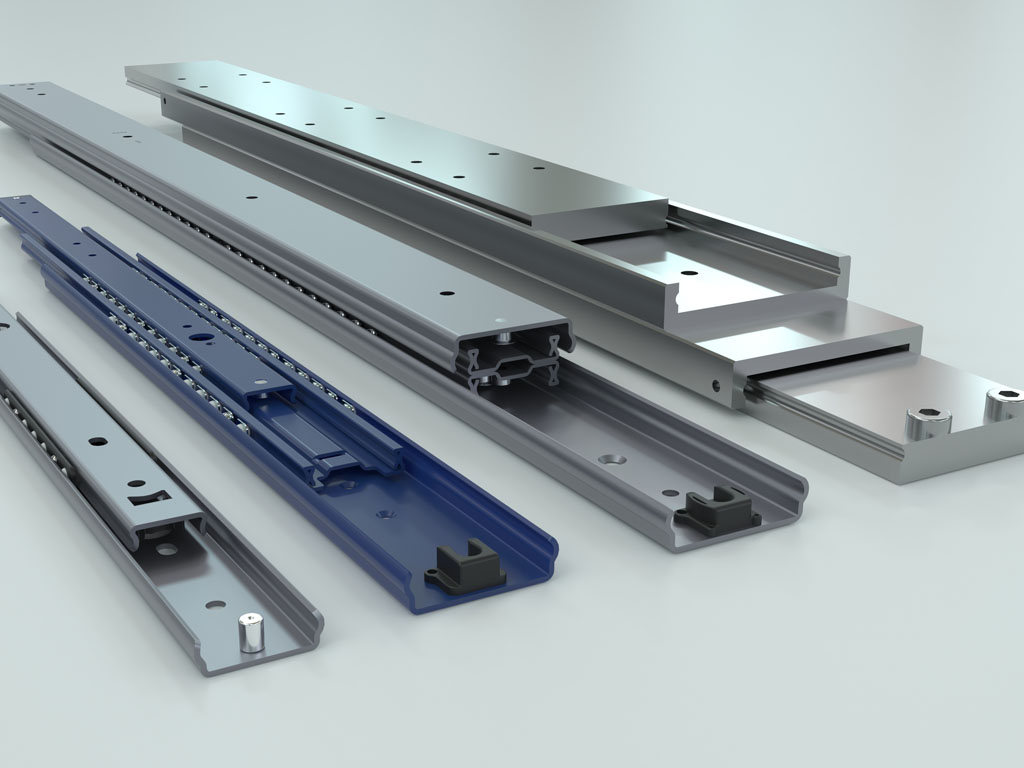
A telescopic slide can deflect under load if the selected model is unsuitable for the operating load or the mounting arrangement. The most common causes are an underestimated load, an unsuitable slide type or an installation that differs from the manufacturer’s specifications.
What causes a telescopic slide to deflect?
In machinery and industrial equipment, several factors often act together. Check the load rating and the way the slide is installed and used.
- Load above the rated capacity. Check the rating for the exact slide length and mounting conditions. Overloading can cause excessive deflection or permanent damage.
- Long travel or an offset load. As the load moves farther from its support, the bending moment increases. Check the position of the centre of gravity at full extension.
- Incorrect mounting orientation. A rating for side mounting cannot be transferred to flat or inclined mounting. Use the value specified for the actual orientation.
- Inadequate fastening. Too few fasteners or incorrectly placed mounting points can concentrate the load.
- Shock and vibration. Abrupt stops, vibration and repeated opening and closing under load can increase the forces on the slide.
Check these conditions during design so you can distinguish an installation or sizing issue from a fault in the slide.
How do you determine the required load capacity?
Start with the total weight of the moving assembly, including the drawer or carrier and its contents. Then account for the travel, mounting orientation, operating conditions and any safety margin required for the application.
Distinguish between static and dynamic loads
A static load acts while the assembly is at rest. Dynamic loads arise when it moves, accelerates, stops or is exposed to vibration or impact. For industrial equipment, check the expected operating conditions and cycle count against the data sheet for the selected slide.
Account for leverage and travel
At full extension, the distance between the load’s centre of gravity and its support affects the bending moment. Use the manufacturer’s load and deflection data for the chosen length and mounting arrangement. Where the load is offset or subject to shocks, have the selection checked for the actual application.
Which types of slide suit high loads?
The required access to the assembly determines the extension type. Compare the load ratings of the individual series and lengths to find a suitable slide.
- Partial extension. The assembly opens part of the way. This can suit installations where access to the rear is unnecessary.
- Full extension. The travel is approximately equal to the closed length of the slide, giving access to the back of the compartment.
- Over-extension. The travel exceeds the closed length. Check the effect of the longer travel and the position of the load when the assembly is fully open.
Galvanised steel is an option for many industrial applications. Stainless steel can suit damp or corrosive environments, while aluminium helps where the weight of the assembly matters. Check the series-specific load rating for each material.
How can installation reduce deflection?
Mount the slide in the orientation specified for the selected rating, keep the mounting surfaces flat and rigid, and distribute the load as evenly as the design allows.
- Spacing and load distribution. For ratings stated per pair, mount both slides at the specified spacing and check how the load is shared.
- Flat mounting surfaces. Uneven surfaces can put the slides under tension and make the assembly harder to move.
- Correct fasteners and mounting points. Use the specified fasteners and mounting positions.
- Installation orientation. Confirm that the slide is approved for the intended side, flat or inclined mounting arrangement.
When is a custom slide worth considering?
A custom slide may be appropriate when a standard model cannot meet the required load, travel, available space or mounting geometry. The same applies if the environment calls for a particular material or finish, or if the slide must be integrated into a larger assembly.
- The required length or load falls outside the standard range.
- The available space requires a different profile or fixing pattern.
- The environment calls for a specific material or surface treatment.
- The assembly requires a particular stop, lock or self-closing function.
How SCHOCK can help with slide selection
SCHOCK develops and manufactures ball-bearing telescopic slides in Europe. The range includes partial-extension, full-extension and over-extension slides in galvanised steel, stainless steel and aluminium, as well as custom designs and assembled units.
Our heavy-duty telescopic slides reach up to 2,500 kg per pair and lengths up to 3,000 mm, depending on the model. To help us assess your application, send us the total moving load, the available closed length, the required travel and the mounting orientation. Contact SCHOCK for technical advice.