
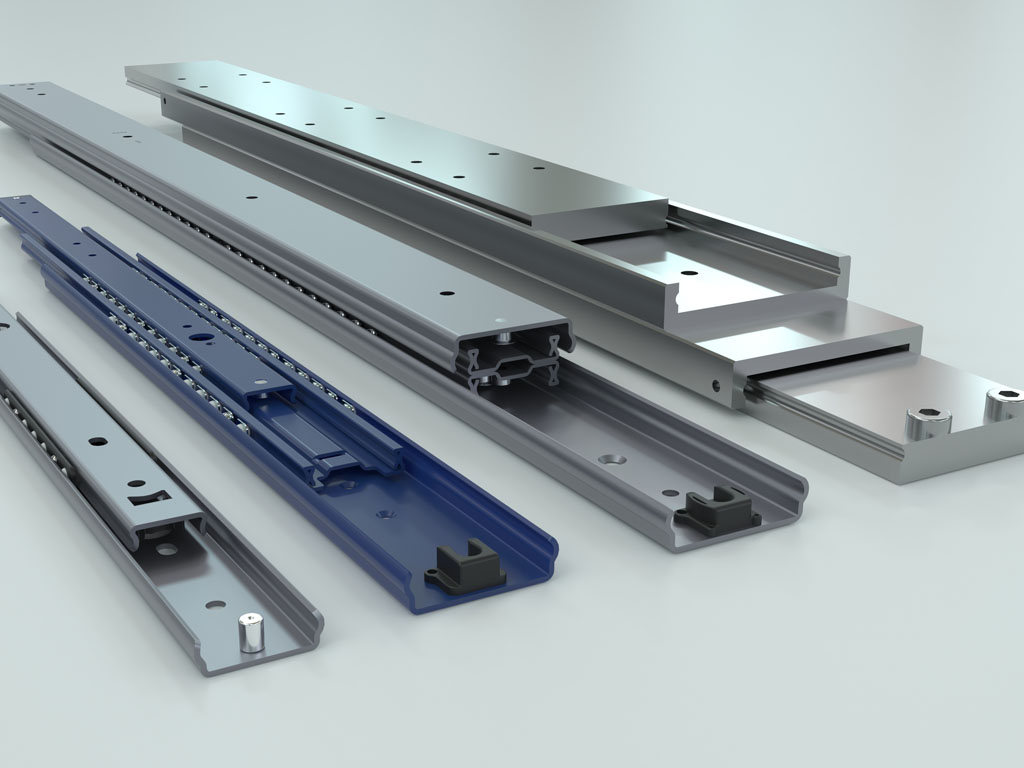
The mounting orientation of a telescopic slide affects how load is shared between the profiles, balls and raceways. A slide may wear more quickly or deflect more if it is mounted in an orientation that differs from the one used for its load rating. Check the orientation alongside the load, travel and closed length when specifying a slide.
Why does mounting orientation affect service life?
A slide is designed to carry forces in a specified direction. Side loads or twisting moments can concentrate the load on part of the bearing assembly. This can increase friction and wear, particularly where the assembly is opened frequently under load or subject to shocks.
Distinguish side mounting from flat mounting
Side mounting
A drawer can travel horizontally while its slides are mounted vertically on the sides of the cabinet. Check the data sheet for the load capacity and fastener layout for this arrangement.
Flat, inclined, vertical-travel and overhead installations
A slide laid flat under a drawer has a different load orientation from a side-mounted slide. Flat, inclined and overhead mounting, and applications where the slide itself travels vertically, each need to be checked for the selected series. Use the load rating specified for the actual arrangement and confirm any special installation requirements with the manufacturer.
How load direction affects the ball bearings
An offset load, misalignment or sudden stop can increase the forces at individual contact points. Repeated overloading can damage the raceways and make the assembly noisier or harder to move. Check where the load acts at full extension and consider the forces during operation as well as the weight at rest.
Common installation errors
- Mounting the slides on surfaces that are uneven, out of parallel or insufficiently rigid.
- Using a different fixing pattern or fewer fasteners than the data sheet specifies.
- Exceeding the rated load for the selected length, travel or orientation.
- Using unsuitable or incorrectly positioned stops.
- Allowing dirt or cleaning residues to build up, or using a lubricant that the manufacturer does not specify.
When to consider a heavy-duty slide
Consider a heavy-duty or reinforced model when the application has high loads, frequent operation under load, shock, vibration or a significant offset. Check that the selected series is approved for the intended mounting orientation. If the application is unusual, have the selection reviewed.
Installation checklist
- Check the load rating and mounting instructions for the specific series and length.
- Make sure both mounting surfaces are flat and parallel.
- Use the specified fasteners, fixing points and tightening torque.
- Follow the manufacturer’s instructions for cleaning, inspection and lubrication.
- Check that stops and any required locking devices are suitable for the application.
Technical advice from SCHOCK
Explore the technical details for SCHOCK telescopic slides or compare the heavy-duty range. When you contact us, include the mounting orientation, available closed length, travel and total moving load so we can assess the application.